
Capitalism and Collapse: Why Ending Capitalism Won’t Save Us
Abolish capitalism tomorrow, and collapse would come even quicker

Editor’s note: My earlier essay, Collapse: A Framework sets out the structural dynamics of overshoot and collapse. This essay explores the relationship between capitalism, ecological overshoot, and collapse.
1. The Wrong Diagnosis
It is easy to believe collapse is caused by capitalism - by greed, profit, elites, and short-term thinking. The story feels neat and tidy. It gives us villains to condemn and a moral fix to imagine. We look for villains because blame feels easier than acknowledging limits. Replace the system, we tell ourselves, and we could finally live sustainably.
But the problem runs deeper and cuts across ideology. Capitalism has accelerated collapse, but it did not cause it. Even if we replaced it with something fairer, socialism for example, collapse would still be coming.
Because the real issue is industrial civilisation itself.
The systems that sustain billions of us, including industrial agriculture, transport, global trade, and fossil energy, are the same systems driving ecological breakdown. Without them, billions will die. With them, overshoot deepens until ecosystems fail, and billions will still die.
We are trapped in a paradox. The same machinery that feeds and shelters us is dismantling the conditions for our survival. Capitalism did not create this trap, but it perfected it.
2. The Surplus Instinct
Long before markets or money, humans were wired to seek and store surplus. The groups that gathered more food, preserved more meat, or controlled access to resources were the ones who survived hard seasons and reproduced. The pattern was simple: expand when energy is available and compete for control of surplus. Over time, that behaviour became part of our evolutionary success.
When agriculture emerged, the instinct scaled up. Surplus grain meant more births, larger settlements, rising hierarchy, and eventually armies to protect the stores. Every civilisation, from Mesopotamia to the Maya, grew until its ecological base began to fail¹². Growth was not a cultural choice but a biological reflex reinforced by success.
Capitalism inherited this logic. It did not invent growth; it industrialised it. It turned our deep evolutionary bias for surplus into a planetary operating system. The same neural circuits that once stored winter roots now drive data centres, supply chains, and financial markets. We call it progress, but it is the same pattern in carbon and code.
3. The Industrial Miracle
The real turning point was not capitalism but coal. Fossil energy gave us access to hundreds of millions of years of stored sunlight³⁴. For the first time, humans could multiply without facing immediate ecological feedback.
That surplus reshaped everything. Populations rose from the hundreds of millions pre-industrial to more than eight billion today. Machines replaced muscle, fertilisers replaced fallow, antibiotics outpaced infection, and global trade outran local limits. Capitalism emerged as the mechanism that organised this expansion, a social technology for managing abundance. Socialist and planned economies followed the same energetic curve. Every ideology built its promises on an expanding foundation of fossil energy.
Industrial civilisation is built on a one-time geological windfall. Fossil fuels allowed humanity to exceed the planet’s carrying capacity by substituting energy for ecosystem function. This created comfort, complexity, and dependence on systems that cannot be sustained.
The result was a sudden release of human biotic potential. With abundant energy, food production and survival rates soared. Populations that would once have been limited by local ecosystems were freed from those checks. The industrial surplus allowed humanity to multiply far beyond the planet’s natural carrying capacity. What we call overpopulation is not a separate problem but the biological outcome of energy abundance⁵⁶.
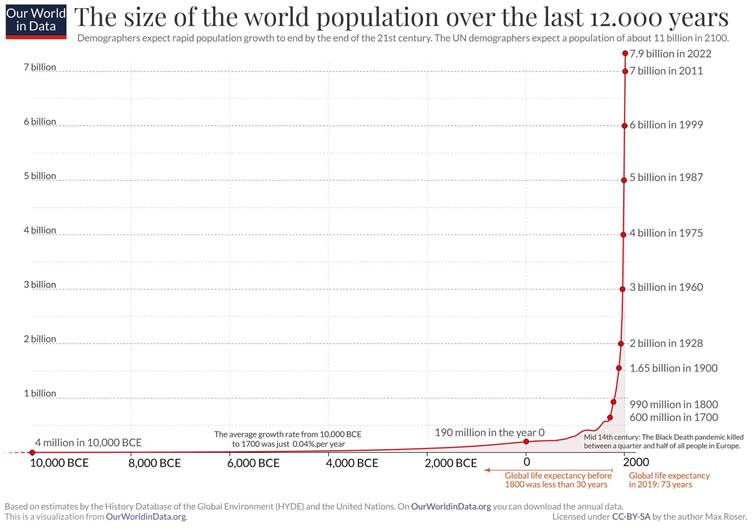
Fig 1: World Population (Source: Our World in Data)
The comfort and complexity built on this temporary energy windfall cannot last forever. Every surplus carries its own collapse within it - which brings us to the paradox at the heart of industrial civilisation.
4. The Collapse Paradox
Industrial civilisation guarantees collapse, whether we keep capitalism or not.
If we continue with capitalism’s growth logic, overshoot deepens until the biosphere can no longer absorb the damage. Climate instability, soil depletion, ocean acidification, and biodiversity loss converge into systemic failure.
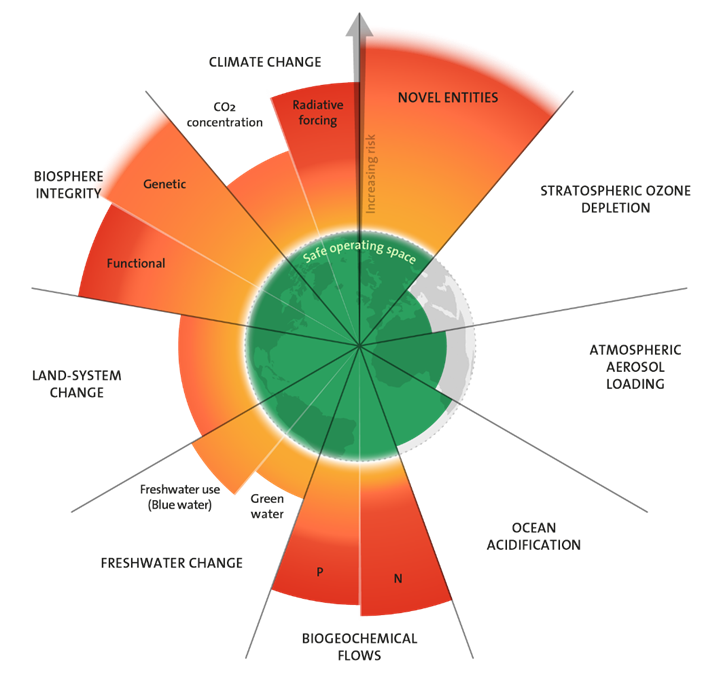
Fig. 2. The 2023 update to the planetary boundaries (Source: Azote for Stockholm Resilience Centre, Stockholm University. Based on Richardson et al. 2023, Steffen et al. 2015, and Rockström et al. 2009).
If we abandon capitalism and dismantle the industrial infrastructure that feeds and shelters billions, collapse still follows, only faster. Without synthetic fertilisers, mechanised agriculture, shipping, and global trade, most of humanity loses access to the calories, clean water, and medicine that keep us alive.
Collapse is delayed only by the time lag between cause and consequence - the inertia of a system still burning through its stored energy and awaiting the consequences of environmental transgressions long past. Collapse is delayed by momentum, like a train still moving long after the brakes are applied.
The Arctic’s ice–albedo feedback shows how cause and effect no longer align in time: sunlight absorbed today commits the planet to future warming long after the ice is gone.
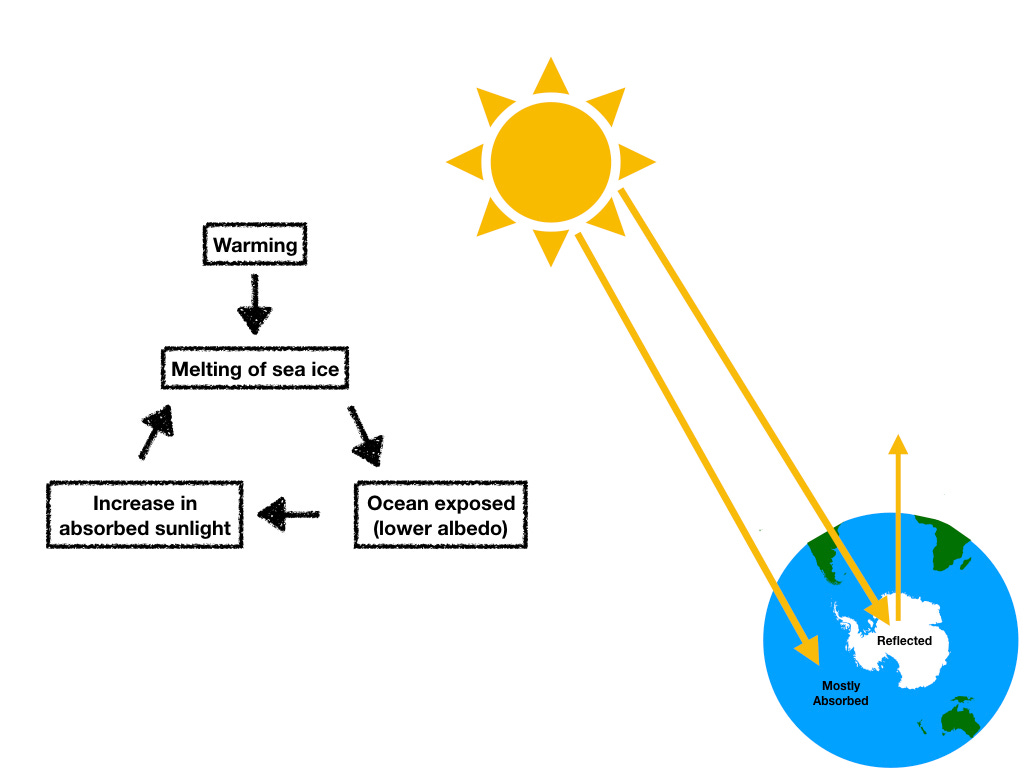
Fig 3: Ice–albedo feedback (Source: Wikipedia)
We cannot walk away from the machine without mass death, and we cannot keep running it without destroying the living world. That is the paradox that defines our age⁷⁸.
Capitalism ensures collapse through expansion. Ending it ensures collapse through contraction. The only variables are timing and scale.
5. The Ideological Distraction
Capitalism’s critics are right about its destructiveness but wrong about its uniqueness. Every modern ideology (socialist, communist, or neoliberal) has relied on the same exponential use of energy and materials. The Soviet Union deforested Siberia, the West paved continents with roads, and both filled our shared atmosphere with carbon.
The real divide is not left versus right but industrial versus ecological. Industrial systems, regardless of ownership, depend on continuous energy surplus and material throughput. Ecological systems operate within feedback loops and limits. The clash between them defines our time.
This is why post-capitalist dreams that preserve industrial scale are illusions. Green growth, circular economies, and renewable transitions all assume complexity can be sustained without cost. This defies biophysical reality. Renewable infrastructure still depends on global mining, transport, and manufacturing networks. Energy transitions can change the source, but not the scale, of consumption. The energy from daily sunlight cannot match the energy density of millions of years of fossil sunlight⁹³.
Ideology becomes a distraction, a way of preserving the fantasy that collapse is a choice rather than the outcome of ecological overshoot and human overpopulation.
6. Living After the Illusion
Collapse is not a policy failure that can be voted away. It is an ecological correction to centuries of overshoot. The question that remains is how we live within it.
For now, industrial civilisation continues on momentum, a vast machine coasting on stored energy and feeding on its own foundations. As energy returns decline and systems strain, we will rediscover that what felt permanent was only temporary.
What matters is how we carry ourselves through descent. Restraint instead of extraction. Reciprocity instead of exploitation. Repair instead of denial. These are resilience traits for a contracting world.
Capitalism will not survive collapse. Nor will any industrial system that believes it can outsmart physics¹⁰⁵. The task is to live within limits, to build cultures that no longer mistake surplus for progress, and to rediscover our ecological identity.
If you want to support my work, please like, share, or subscribe.
References
1. Tainter, J. A. (1988). The Collapse of Complex Societies. Cambridge University Press.
2. Diamond, J. (2005). Collapse: How Societies Choose to Fail or Succeed. Penguin.
3. Smil, V. (2017). Energy and Civilization: A History. MIT Press.
4. Odum, H. T. (1996). Environmental Accounting: Emergy and Environmental Decision Making. Wiley.
5. Catton, W. R. (1980). Overshoot: The Ecological Basis of Revolutionary Change. University of Illinois Press.
6. Rees, W. E. (2020). The human ecology of overshoot: Why a major population correction is inevitable. Ecological Economics.
7. Ophuls, W. (2011). Immoderate Greatness: Why Civilizations Fail. CreateSpace.
8. Meadows, D. H., Meadows, D. L., Randers, J., and Behrens III, W. W. (1972). The Limits to Growth. Universe Books.
9. Hagens, N. (2021). The Great Simplification. University of Minnesota.
10. Ophuls, W. (1977). Ecology and the Politics of Scarcity: Prologue to a Political Theory of the Steady State. W. H. Freeman.
An excellent analysis Adrian. People spend so much time worrying about politics, when in fact its power to fix anything profound like Collapse is practically zero. Politics is the third of the great human delusions. It exists nowhere except in the human mind. But people love it because it is a game, an entertainment, with winners and losers - but seldom a solution to anything. Arguing over which political system or leader will prevent collapse is like pretending Frodo is real.
“Every civilisation, from Mesopotamia to the Maya, grew until its ecological base began to fail¹². Growth was not a cultural choice but a biological reflex reinforced by success.” If you haven’t, I’d encourage you to read The Dawn of Everything” by Graber and Wengrow for a convincing refutation of this assumption. Not that many societies didn’t follow this path but that it is a cultural not biological choice.
I’d also argue that there are more possible paths forward than that only industrial agriculture can feed this many humans. However, broadly speaking, we as a global society do seem to be following the path you outline. My point is simply there is proof in the historical record that other paths exist.